What Are You Looking For?
who's looking for who

John 1:29–42 (NRSV)
29 The next day he saw Jesus coming toward him and declared, “Here is the Lamb of God who takes away the sin of the world! 30 This is he of whom I said, ‘After me comes a man who ranks ahead of me because he was before me.’ 31 I myself did not know him; but I came baptizing with water for this reason, that he might be revealed to Israel.” 32 And John testified, “I saw the Spirit descending from heaven like a dove, and it remained on him. 33 I myself did not know him, but the one who sent me to baptize with water said to me, ‘He on whom you see the Spirit descend and remain is the one who baptizes with the Holy Spirit.’ 34 And I myself have seen and have testified that this is the Son of God.”
35 The next day John again was standing with two of his disciples, 36 and as he watched Jesus walk by, he exclaimed, “Look, here is the Lamb of God!” 37 The two disciples heard him say this, and they followed Jesus. 38 When Jesus turned and saw them following, he said to them, “What are you looking for?” They said to him, “Rabbi” (which translated means Teacher), “where are you staying?” 39 He said to them, “Come and see.” They came and saw where he was staying, and they remained with him that day. It was about four o’clock in the afternoon. 40 One of the two who heard John speak and followed him was Andrew, Simon Peter’s brother. 41 He first found his brother Simon and said to him, “We have found the Messiah” (which is translated Anointed). 42 He brought Simon to Jesus, who looked at him and said, “You are Simon son of John. You are to be called Cephas” (which is translated Peter).
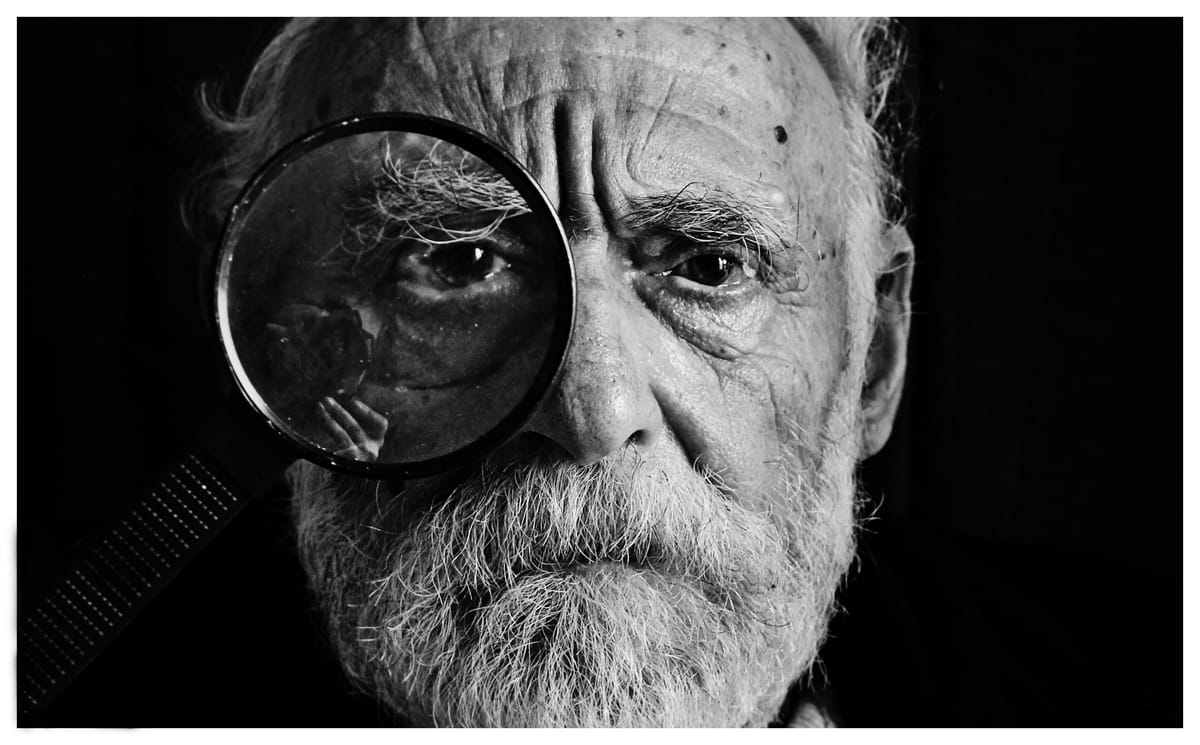
“What are you looking for?”
The question hung in the air between Jesus and these seekers. They had been disciples of the wild man John the baptizer, but now they were following someone different, someone new.
John told them that this man was the Lamb of God, the one sent to restore Israel, the one whom John had been preparing the way for. John told them that this was the one who takes away the sin of the world. John told them that this was the man whom he had been waiting for, the one who was the fulfillment of all that John had been promised to bear witness to, the Messiah.
So, these seekers, these disciples of John the baptizer left what they knew, left what they had committed to practice, left their teacher, their master, their leader, and began following Jesus.
This action was right and proper for their time. John was releasing his disciples to go follow someone who was greater than John. If John’s ministry was fulfilled with the public appearing of Jesus, then those that followed John should turn their eyes upon the one who fulfilled their master’s teachings, who was in alignment with God’s plan for Israel, who had more authority than John.
So, these disciples left John, and began to follow a new teacher, a new master.
And Jesus asked them to tell him what they wanted from him.
“What are you looking for?” is a question of discernment.
It’s a question crafted to make you stop, to think, to listen to your heart. It’s a question that demands an answer. It’s a question that reveals why you’ve sought attachment to Jesus.
The ex-disciples of John answered by seeking where Jesus was staying, signaling they were interested in being with him, in learning from him, in letting him be their Lamb of the World.
Jesus doesn’t stop asking this question. “What are you looking for” is an invitation to introspection. It’s a question of motive. It’s a question designed to unpack the heart’s narrative we are telling ourselves.
What comes up as you sit with this question?
What are you looking for?
Security?
A place to belong?
Maybe a savior?
Strength?
Solace?
Renewal?
Power?
Blessing?
What is it we are looking for when we come to Jesus?
I can’t answer that question for you. You’re the one who knows what’s in your heart, your hurt, your need.
Here’s what I want you to hear very clearly: Whatever you come looking for in Jesus isn’t wrong. It’s not wrong to have a perceived need. It’s not wrong to hope Jesus will fill what you feel is lacking in your life. It’s not wrong to desire.
We all come to Jesus for various reasons. I came to Jesus originally because it’s what I inherited from my ancestors. I stayed with Jesus because I desperately wanted—still do—love.
Our felt needs aren’t wrong. This life is hard, and through trauma and Trauma we are left bleeding on the battlefield. There is no one universal shape of the wounds each of us carry. There is no God-shaped hole in our life or one true desire underneath everything. We are complex creatures, containing multitudes, and we all have been hurt in many various ways. Your story is different than mine, and no one else has my exact story.
It’s okay to want and to look to Jesus for that want.
But sometimes Jesus isn’t the fulfillment of that desire.
Sometimes we come to Jesus, and we find that despite our work to faithfully follow this wild Lamb of God we are left still hurting, still hollow, still bleeding out in the midst of life. Sometimes we get hurt further as we try to follow Jesus. When the institutions that claim his name wound instead of triage, biting our gentle inching closer, rejecting our efforts to belong in that place, we can feel so far from Jesus, riddled with new holes, wondering if a balm exists anywhere.
Here is the honest truth I have found from living a lifetime with Jesus: Jesus is not the solution.
But..
In the confusion, the doubt, the hurt, Jesus simply doesn’t leave.
Jesus is not a solution, but he is a presence.
He is the presence.
I have tried to leave Jesus, to stop following, to give up and throw myself to the sharks of cynicism and nihilism. I have tried walking away, burning the bridge to my theology, to exorcise the Spirit from my life. And Jesus’ response to my punching him in the face? He holds on tighter.
It’s not a desperate clinging as if he is filled with anxious attachment and needs me to stay. No, it’s a grasp, a hold, an embrace. I kick, and he takes a step closer. I throw a haymaker; he takes it and extends his arms. I run, and he simply matches my stride.
Jesus doesn’t let go.
He remains.
Jesus isn’t the solution to pain and suffering. He’s not a magic wand that we can wave and be healed. Healing is our capacity and our work. Jesus won’t take that work from us, won’t steal our agency to grow, to change, to heal. Jesus simply stays with us.
Through tantrums and traumas, Jesus stays.
Through nights of weeping and gnashing our teeth, Jesus stays.
Through our distractions, addictions, and attachments, Jesus stays.
Jesus simply refuses to leave.
This is what it means for divinity to be in solidarity with us.
Jesus became us. He didn’t just slip on a human suit, fix his tie, and walk among us as a luminous being contained. He didn’t change away from being the fullness of God to take some lesser form.
God in God’s full capacity and measure chose to become fully, utterly and in every way human while retaining everything the invisible, ineffable God is.
I confess I don’t understand it.
But I believe it.
I have to because Jesus has proven that this crazy God refuses to leave my life. He stays through my pain, through my anger, through my helplessness. Through the ways I harm myself, and the ways I harm others. Throughout everything it means to be human, I am face to face with the reality that Jesus is my brother and he chooses to remain in relation and proximity with me. He remains closer than my next breath, yet he refuses to steal from me my identity as everything I am.
“What are you looking for?” is Jesus inviting himself into our lives to help us look for what we desire, what we need. It is Jesus coming close to us, offering a presence that we can’t shake.
Offering love that won’t give up.
This is the core of what it means to follow Jesus: we become aware in ever-increasing measure of the unbridled love Jesus has for us.
Jesus loves each of us by name.
That’s why he remains. That’s why he is the God of solidarity. That’s why he won’t let us go.
Jesus loves me; this I know.
Jesus loves you; this I know.
I look to the presence of Jesus—the incarnation, the life, the passion, the cross, the resurrection—and I am left face to face with the reality that the God that is beyond what I can ever hope to know loves us. Each of us. And not a generic warm fuzzy for humanity as a whole. No.
God knows your name.
God sings a special song just for you.
God wants to be with you.
God yearns for you.
You are the apple of God’s eye, the one God likes to be around, the one God can’t let go of because God’s love is too overwhelming.
So Jesus—the Lamb of God who takes away the sins of the world—is the fullness of this God who empties Godself and becomes fully one of us to be in solidarity and hold presence with each of us.
No matter what you come to God looking for, God comes looking for you.
I am in the process of becoming a community chaplain with The Order of Hildegard. This program is designed to help form people into spiritual leaders that lead and serve from the margins. It’s for the people who don’t quite fit with the traditional church because of trauma, disability, or identity. If you, as my community, would like to help me fulfill the financial obligation this chaplaincy program has, you can give at the link below. Thank you for the myriad ways you support me.
If you’re aching to listen for God in the real stuff of life—grief, wonder, doubt, desire—I offer spiritual direction as a space to breathe and be heard. We listen together for the Spirit moving in the ordinary, the hidden, the in-between. No fixing. No formulas. Just presence, honesty, and room to be fully human before God.
If that sounds like what your soul needs, I’d love to walk with you