Christ The Crucified King
a revolutionary death

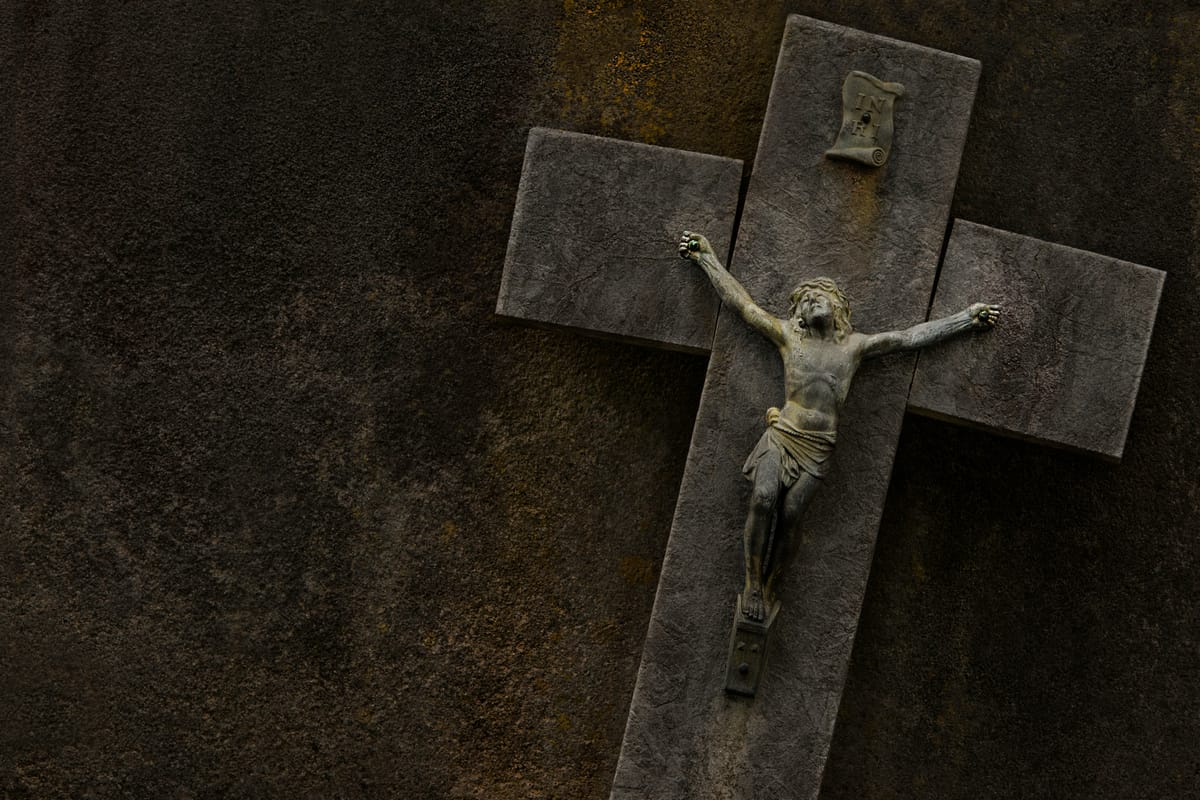
Luke 23:32–43 (NRSV)
32 Two others also, who were criminals, were led away to be put to death with him. 33 When they came to the place that is called The Skull, they crucified Jesus there with the criminals, one on his right and one on his left. [[34 Then Jesus said, “Father, forgive them; for they do not know what they are doing.”]] And they cast lots to divide his clothing. 35 And the people stood by, watching; but the leaders scoffed at him, saying, “He saved others; let him save himself if he is the Messiah of God, his chosen one!” 36 The soldiers also mocked him, coming up and offering him sour wine, 37 and saying, “If you are the King of the Jews, save yourself!” 38 There was also an inscription over him, “This is the King of the Jews.”
39 One of the criminals who were hanged there kept deriding him and saying, “Are you not the Messiah? Save yourself and us!” 40 But the other rebuked him, saying, “Do you not fear God, since you are under the same sentence of condemnation? 41 And we indeed have been condemned justly, for we are getting what we deserve for our deeds, but this man has done nothing wrong.” 42 Then he said, “Jesus, remember me when you come into your kingdom.” 43 He replied, “Truly I tell you, today you will be with me in Paradise.”
What does the cross of Jesus mean for us when we are suffering?
This over two-thousand-year-old story of an event of tragedy, pain, and sorrow has been handed down to us from our ancestors, given to us as the once and for all faith. It is a core Christian belief, a day through which we see everything has changed and that there is a reality of reconciliation for us all. We carry the “old rugged cross” deep, deep in our belief system, its story being a major point even in the Christian year.
We sing about it. We wear it as a reminder and a fashion accessory. Here I am preaching about it. To be a Christian is to live in the shadow of the cross. To try to follow Jesus into the place of love is to pick up our cross and follow him.
But what good is all of this to the victims of the terrorism of ICE?
How does the cross speak to people of color who live in the reality of racial slurs, bigotry, and violence?
Why does the crucifixion matter to a trans person whose rights are being taken away at an astonishing speed?
Who benefits from the cross when a queer kid is kicked out of their parents’ house because of who they are?
When will the cross intervene in trauma, abuse, and victimization?
What good is the crucifixion amid the reality of our broken world?
The cross and the crucifixion have been over-spiritualized to the point that it has lost its meaning. We have been told that it is on the cross that we see God’s wrath appeased by the death of his only son. We have been taught that this substitution is the lens by which we are to understand the meaning of the crucifixion. But, if we believe this, if we accept this horrific doctrine, our lives remain unchanged. We still stuffer. We still see oppression all around us.
The reality of our country’s quick slide into authoritarianism and blatant oligarchy affects even those who accept this penal substitutionary atonement. There is no escaping the systems of oppression and dominance. They pervade our lives, and even a history-marking event such as the crucifixion of Jesus cannot break their hold on our lives.
Or can it?
What if I told you that the crucifixion was the revolution against capitalism, white supremacy, and patriarchy? What if I told you the cross was key to tearing down the powers and principalities, the forces that animate the systems of oppression in our world? What if I blatantly said that the crucifixion is the clearest place where we see the remedy to our suffering, where we see the glory of Christ the king?
Would you believe me?
Could you believe me?
Do you want to believe me?
How can it be that the death of divinity can be our hope? In what way—other than spiritual, which has been emphasized to the point of nausea—could Jesus’ death matter to us across the two thousand plus year cultural divide? Why does the crucifixion of the Son of God mean anything to our suffering?
In short, it means that we don’t suffer needlessly.
Because of who Jesus is and how he reacted to his own suffering at the crucifixion, we are given a gift, a new way to exist amid the suffering we endure, knowing that the suffering and oppression we experience is not meaningless.
I’m not suggesting that suffering and oppression don’t hurt—they do. A lot. Our hearts and souls are tattered by the crushing wheels of the empire. Our bodies feel the trauma, both physical and emotional. Our minds are full of reticulated fear and anger because of the overwhelming news cycle.
Suffering hurts.
We can’t forget this.
But it’s not pointless.
Our suffering is the direct result of our rebellion and resistance against the systems of dominance.
The more we resist, the more we will suffer because our resistance is the death knell for the empire. Our rebellion is what will undo the systems of oppression. The revolution Jesus started is the alternative life we can now begin to lead, bearing witness to another way, and another world, a whole other kingdom rooted in love, in equality, and mutuality.
Don’t be mistaken, Jesus’ crucifixion was the seed of this revolution. On the cross, the kingship of God was revealed. The death of God was the divine coronation of the king of love.
Jesus suffered because he was a threat to the system of dominance and violence that is so prevalent in this world. Jesus’ threat to the system didn’t depend on the promise of violence and destruction. Jesus didn’t come using oppression of his enemies. No, Jesus forgave those who persecuted him, even from the cross. Jesus’ power and threat to the system of empire came because he refused to play by the rules of empire.
Jesus came in humility, in smallness, in gentleness and love. Jesus didn’t establish and reveal his kingdom through power, strength, and a display of might. Jesus came to proclaim a softer kingdom, a kingdom where there was no hierarchy, no dominance, no oppression. Jesus’ kingdom isn’t built on the backs of workers, slaves, or soldiers. Jesus’ kingdom is grounded in who he is, in his character, in his nature.
This gentle healer who won’t break a bruised reed or put out a smoldering wick (Isaiah 42.2-3) is the start, the source, and the sustainer of God’s kingdom of love. That fact is what makes the kingdom of God so dangerous to the world.
By refusing to change his nature, Jesus shows us the nature of God, the God who creates out of love, who moves out of love, who doesn’t violate our autonomy out of love. In the kenosis of God, this divine pouring out of the self, we see the God that stands in opposition to the powers and principalities of this world.
The clearest picture of that kenosis, that self-emptying that is opposition to the world’s systems of dominance and power, is the suffering on the cross.
In the midst of the pain, the agony, the mockery, Jesus didn’t retaliate. He died as an insurrectionist, a violent criminal who was a danger to the stability of the Pax Romana in the area. But that’s not who he was, not who he is.
Jesus wasn’t an insurrectionist. He is a revolutionary, calling us into the places where power dissipates, where oppression, coercion, and violence cease being the currency of exchange, where love and mutual aid become the economy.
If we go to him, if we follow him, if we take up our own crosses, we will suffer. But our king suffered first and then rose from the grave in glory to show us that suffering doesn’t get the last word and that we are all destined for life.
To put plainly what the cross says to our suffering is to look to Jesus as king, not a king enthroned in power and dominance, but crowned with co-suffering love. Jesus as king isn’t some sort of spiritual serfdom. It is the empowerment of all who chase, envision, work for, and testify to the kingdom to be like Jesus.
We are all called to this kenotic love, this self-donating, co-suffering love. This love is what gives meaning to our suffering even as it promises that suffering, evil, oppression, violence, and domination will not be the story that lasts into eternity.
So, we suffer.
But we suffer for the sake of bearing witness to the divine kingdom of love. When we stay uncorrupted and in revolution against the systems, patterns, and powers of this world, we are screaming in the face of the empire that there is a different way to live, that there is a different king, that the kingdom of God is breaking in through us, to us, with us.
The crucifixion is the coronation of a king that cannot be defeated, even by death. And that victory expressed in resurrection changes everything.
I am in the process of becoming a community chaplain with The Order of Hildegard. This program is designed to help form people into spiritual leaders that lead and serve from the margins. It’s for the people who don’t quite fit with the traditional church because of trauma, disability, or identity. If you, as my community, would like to help me fulfill the financial obligation this chaplaincy program has, you can give at the link below. Thank you for the myriad ways you support me.
If you’re aching to listen for God in the real stuff of life—grief, wonder, doubt, desire—I offer spiritual direction as a space to breathe and be heard. We listen together for the Spirit moving in the ordinary, the hidden, the in-between. No fixing. No formulas. Just presence, honesty, and room to be fully human before God.
If that sounds like what your soul needs, I’d love to walk with you